Forget Treasuries: FatMbappe Made World Cup Bets A 260% APY Yield Vault
by @allquantor Financializing the Mets The fundamental problem with sports betting, from a Wall Street perspective, is that it is simply not complicated enough. You bet $100 on the Mets to win

by @allquantor
Financializing the Mets
The fundamental problem with sports betting, from a Wall Street perspective, is that it is simply not complicated enough.
You bet $100 on the Mets to win tonight. Either they win and you get paid, or they lose and you eat a cold hot dog in silence. It’s binary, it’s immediate, and it lives on a phone app right next to notifications from your bank telling you to stop doing that.
If you want Wall Street to take you seriously, you have to turn that hot dog into a continuous derivative.
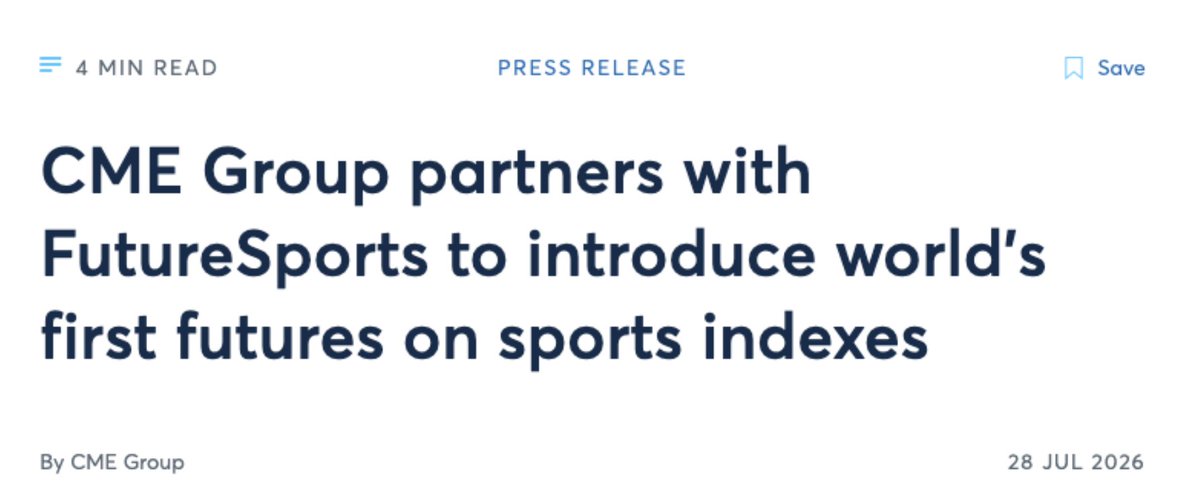
Instead of betting on whether the Mets win tonight, they take every play, win, home run, and player ejection across an entire season and squish it into a single, proprietary number.
The Mets Index starts at 7,500 prior to Opening Day. Why 7,500? Who knows! It’s a nice, respectable-sounding number and then tick-by-tick moves up or down all summer.
Then CME lists a continuous futures contract on that number.
The official narrative is, of course, "risk management." The press releases suggest that sports bar owners outside Citi Field can short Mets Index futures to hedge against terrible draft beer sales if the team collapses in July.
I love the mental image of a local tavern owner staying up until 2:00 AM running a delta-hedged options book on his phone because the bullpen gave up a walk-off grand slam. Is anyone actually doing this? Probably not! Most small business owners just accept that life is hard and beer sales fluctuate.
What people will actually do with this is trade sports with institutional infrastructure:
-
The IRA Advantage: You can now hold a "The Mets are fundamentally misunderstood by the market" position directly inside your brokerage account, right next to your Vanguard index funds, complete with preferential 60/40 capital gains tax treatment.
-
Continuous Action: You don't have to wait for the game to end. If Pete Alonso hits a grand slam in the 3rd inning, your index future ticks up, you hit "sell," and you go buy lunch.
-
The Arbitrage Engine: If the CME Mets Index trades slightly higher than the cost of buying all the individual underlying game-outcome bets on Kalshi or Polymarket, high-frequency traders get to do riskless cross-exchange arbitrage. That is just good, clean wholesome fun for market makers.
Once you have continuous indexes, the next logical step is asset management.
The "Tail-Risk" World Cup Yield Note
Which brings us to @TheFatMbappe and the $FAV8 World Cup Vault on ZEIT.
If you go to a traditional bookie and ask for a payout if any of the top eight favorites wins the World Cup, the bookie will look at you like a mark, calculate a massive multi-way house margin, and give you terrible odds.
On a prediction market, every team's odds trade as an isolated binary contract that pays $1.00 if they win the cup and $0.00 if they don't. Because only one country can lift the trophy, these outcomes are mutually exclusive.
So FatMbappe set up an automated vault that does the following math:
-
It buys 1 share of YES on each of the top 8 favored countries (Brazil, France, Argentina, etc.).
-
The combined cost to buy all 8 shares is $0.81.
-
If any of those 8 teams wins, exactly one contract pays out $1.00 and the other 7 expire worthless.
-
Net profit: $0.19 on an $0.81 investment.
In sports betting, this is called "hoping a favorite wins."
In structured finance, this is a principal-at-risk structured yield note. You are effectively acting as an insurance underwriter, harvesting a ~23.5% - ~260% annual gross yield as long as the world behaves predictably. Your downside where your yield turns into a complete loss is the tail-risk event where an unseeded dark horse like Croatia or Morocco goes on a miracle run and wins the whole thing.
FatMbappe didn't just place a sports bet, he built a high-yield fixed-income product backed by international soccer. And because doing that execution manually across eight order books requires actual effort, he put it in an automated smart contract, took the title of Portfolio Manager, and posted memes on Twitter.

The Bright Side of Financial Complexity
It is easy to be cynical about this and say, "Look, it’s just gambling with extra steps and more Greek symbols." And sure, at the end of the day, someone still has to lose a game for someone else to make money.
But there is something genuinely wonderful happening here.
For a century, traditional sports betting was a rigged game designed by bookmakers to extract a reliable 10% toll from fans. It was opaque, illiquid, and completely isolated from the rest of the financial world.
What prediction markets and index futures are doing is replacing the bookie with transparent, open-source market architecture:
-
Efficiency over Extortion: By unbundling bets into transparent $1.00 binary options, spreads compress. Traders like FatMbappe can capture structural yield that used to get swallowed by bookmaker margins and hand it right back to retail depositors.
-
Creative Freedom: Capital markets are at their best when anyone can construct a hyper-specific risk profile. If you want high-yield exposure to global soccer favorites, or a delta-neutral market-making strategy on baseball statistics, you no longer need a Bloomberg terminal or a private bookmaker - you just need a crypto wallet or a CME clearing account.
Wall Street spent two hundred years making high finance feel like an exclusive, dreary daytime job. These new markets are doing the exact opposite: taking directional sports passion and turning it into an arena for genuinely clever portfolio engineering.
If the future of finance means turning internet traders into quantitative sports macro managers, the future looks pretty entertaining.