Polymarket Doesn’t Have a Money Problem. It Has a Plumbing Problem.
by @allquantor This is a long, semi technical dive into Polymarket's market structure, order-book plumbing, and liquidity cliffs. If you just want to check the math and datapoints, skip straight to

by @allquantor
This is a long, semi technical dive into Polymarket's market structure, order-book plumbing, and liquidity cliffs. If you just want to check the math and datapoints, skip straight to the data folder linked at the very bottom.
Here is a thing about prediction markets: they are a weird hybrid. They are part stock exchange, part casino, part news terminal, and part group chat with financial settlement. When they work, they feel like magic. The crowd updates, the price moves, and suddenly “the market thinks X” becomes a sentence people say out loud and believe. When they do not work, they feel like a website that was extremely confident it had plenty of liquidity right up until the exact moment you tried to click "buy."
If you want to know if a market is actually liquid, there are two ways to find out. One way is to open the app, look at the screen, and nod at the big numbers. The other way is to try to trade a meaningful amount of money in a mildly interesting market at 11:17 a.m. on a Wednesday. The first method is cheaper, much more flattering to the venue, and therefore extremely popular.
But if you look at the actual data and we have a master dataset of 600.82 million raw datapoints here , which we filtered down to a research dataset of 342.99 million by only looking at outcomes with at least 10,000 datapoints than the story is not that Polymarket is an illiquid wasteland. The story is that Polymarket has a very specific kind of liquidity.
It is event-shaped, attention-driven, decent at producing a public price, and much less reliable at absorbing actual size than the headline snapshots suggest.
That is already interesting. But more interestingly, it suggests that Polymarket’s problem is not just “it needs to find more capital.” The problem is “it needs to stop making the same capital sit in ten different buckets pretending to be ten different pools of risk.”
That is the whole article, really. But let’s walk through the plumbing.
To understand the shape of this liquidity, it helps to categorize the order flow. Let's call it soft flow, hard flow, and AI flow. The order book does not come with little name tags telling you who placed what, but as an interpretive framework, this is how you have to think about it:
-
Soft flow is the retail gambler. It is opinion flow, fandom flow, attention flow. It is the “I just read a tweet and now I have a financial position” flow. On average, market makers love soft flow, because it carries low adverse-selection risk. Retail orders generally don't permanently impact prices, and they provide the noise that makes quoting profitable. But this is only true when the flow is broad and unsynchronized. When retail flow herds together and chases momentum, it stops being "soft" and starts being a toxic wave of inventory risk.
-
Hard flow is the professional layer. Market makers, arbitrageurs, inventory managers. These are people who do not say “I have a feeling about the election” - they have dashboards and APIs instead. Hard flow is what makes the market function. It quotes both sides, manages inventory, and earns rewards. But hard flow by itself just gives you a machine; it doesn't automatically make the market feel friendly or deep to an outsider.
-
AI flow is the new middle category. What is an AI bot? An AI bot is basically just retail flow with an API key and no bedtime. Polymarket is structurally practically begging for automation: it has public APIs, order-book feeds, and gasless relayer tools.

That matters because liquidity isn't just a pile of money.
Liquidity is capital, plus attention, plus the willingness to hold inventory, plus your baseline fear of whatever is about to hit you from the other side of the trade.
And on Polymarket, the order book looks radically different depending on which of those three species is currently awake.
Part 1: The Market That Is Liquid on TV
There are, effectively, two Polymarkets.
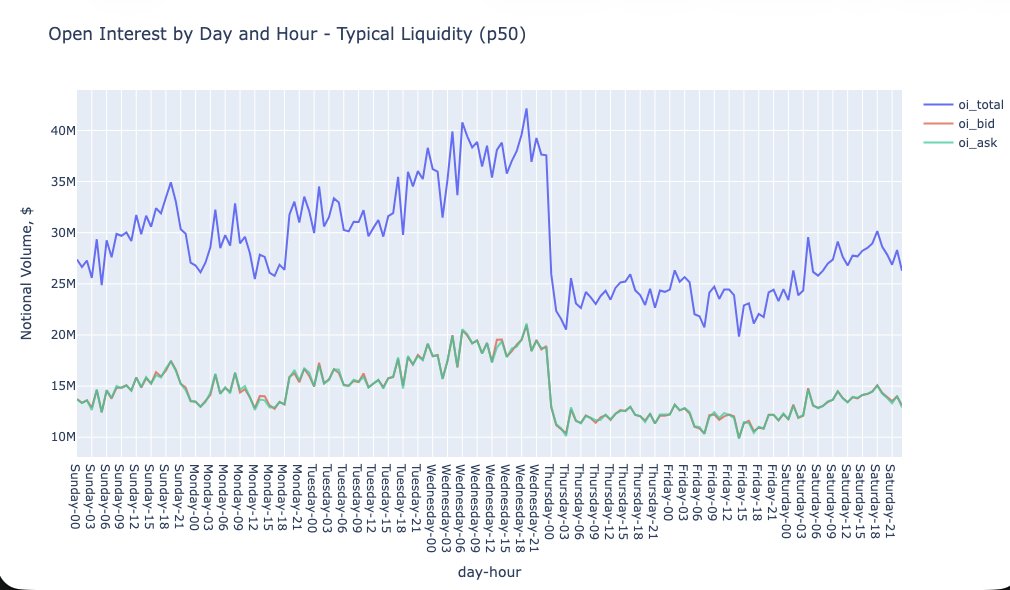
There is the Polymarket of exciting moments the one people screenshot for Twitter to announce that prediction markets are the future of finance. In that Polymarket, there is real size and the venue seems deep and inevitable.
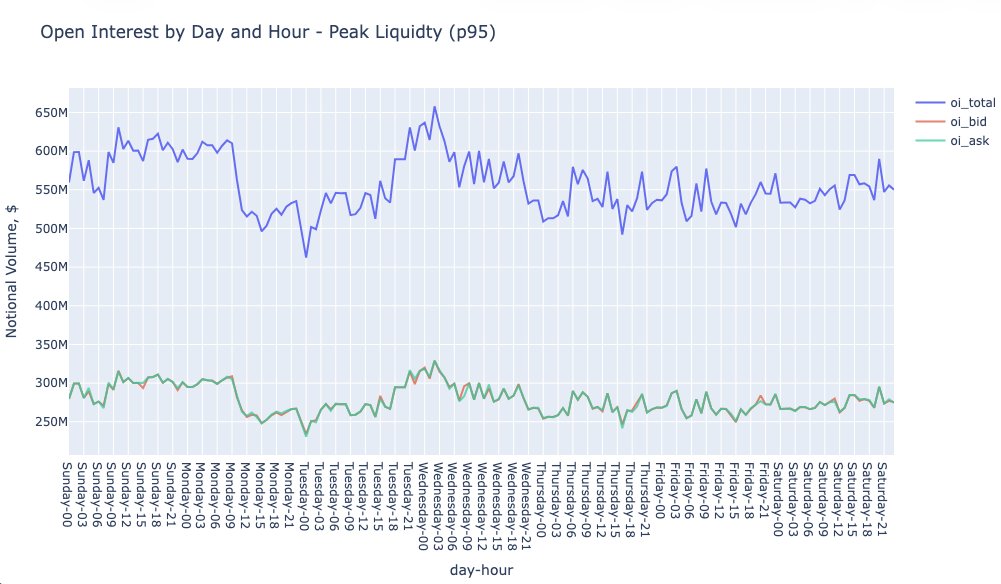
Then there is the ordinary Polymarket, where most trading decisions are actually made. In the data, we measure the "typical" hour (the p50 median) and the "busy" hour (the p95 peak). When the p95 peak is high but the p50 median is low, it means liquidity spikes occasionally but is normally thin. On Polymarket, typical quoted liquidity lives in the tens of millions, while the busy-hour version jumps into the high hundreds of millions.
That is a market with an on-screen personality and an off-screen personality.
Peak liquidity is not fake, it is just episodic. It arrives when the event is hot, when soft flow comes rushing in, and when hard flow decides the market is finally worth servicing aggressively. You can even see the rhythm of daily human life in the data: there is a noticeable drop in open interest during working hours, which supports the highly technical financial hypothesis that the "participants are busy at their day jobs".
The spread chart tells the exact same story. Median spreads are tolerable enough to produce a usable public price. But stress spreads are moody.

When conditions become one-sided, the market makers step back. Soft flow is pleasant to market makers because it is low-adverse-selection; but once the incoming flow starts looking highly synchronized or aggressively fast, it stops being “soft” and starts being something the market makers need to aggressively hedge against.
Then you look at the order book, and you realize it has two completely different personalities.
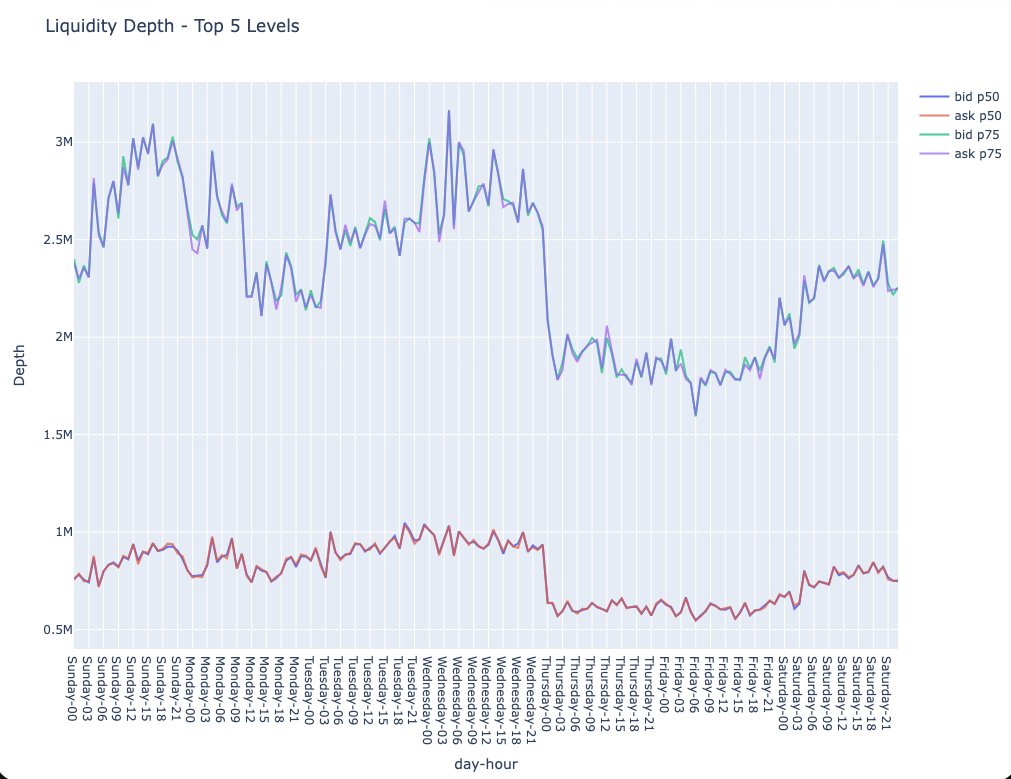
If you look at the very top of the book the top 5 levels it is well balanced, with an occasional very small skew towards bids. The front window is civilized: enough bid, enough ask, enough competition to look like a real exchange.
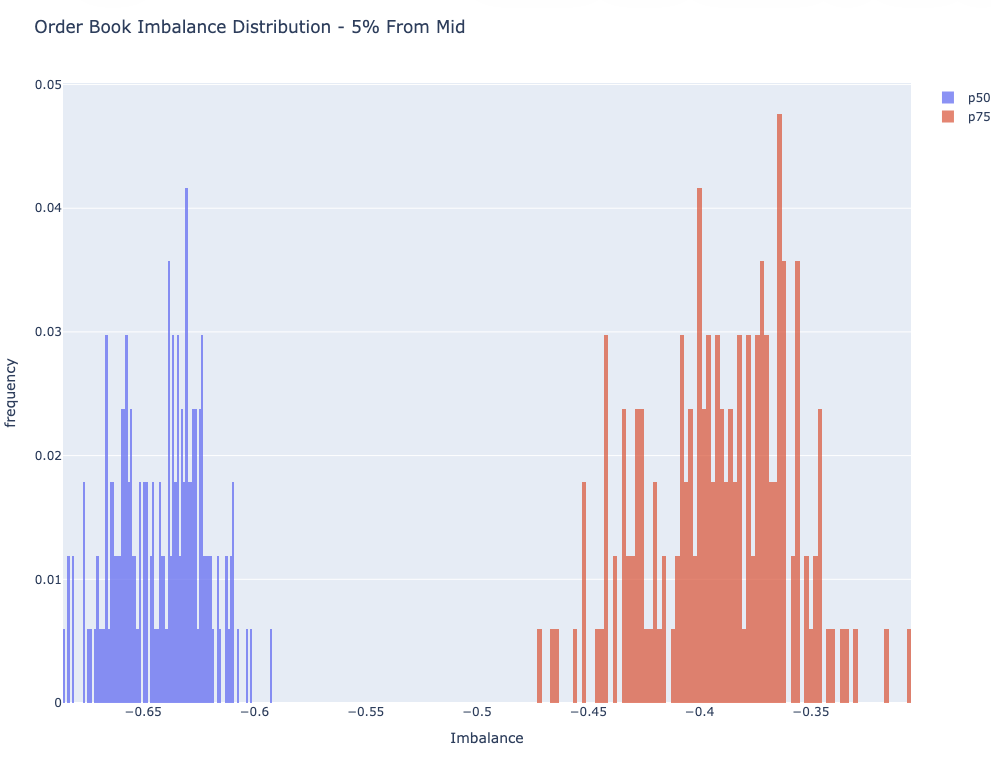
But if you step deeper into the book, 5% away from the mid-price, the symmetry completely breaks down. The deeper levels are systematically skewed towards asks.
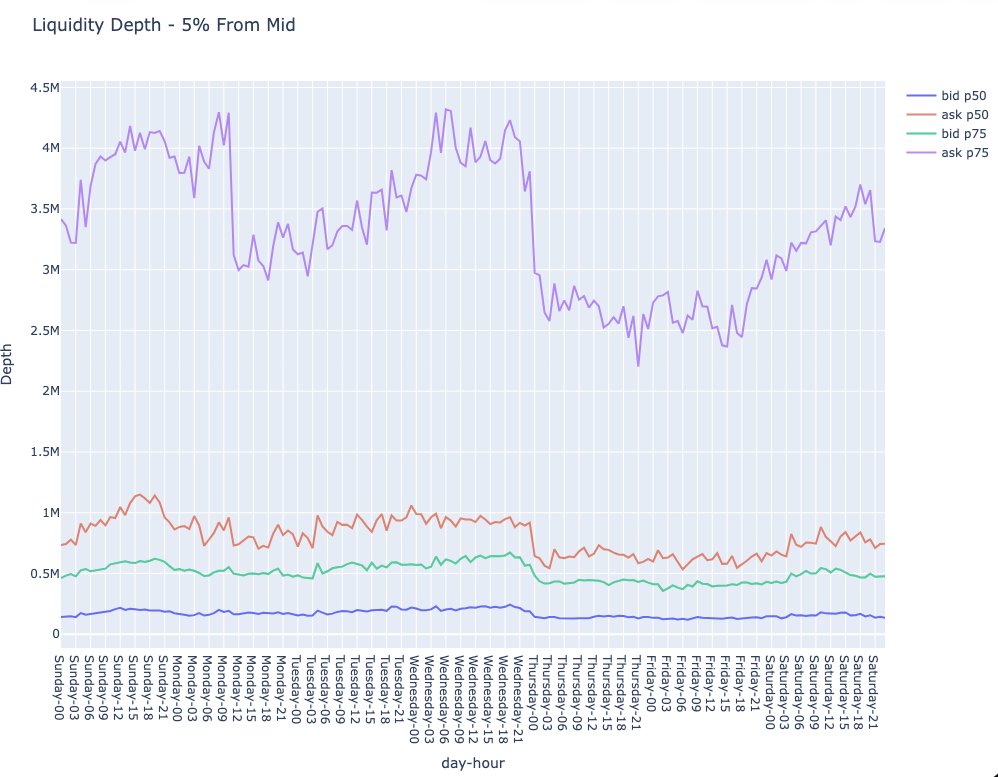
Surface symmetry - subsurface asymmetry.
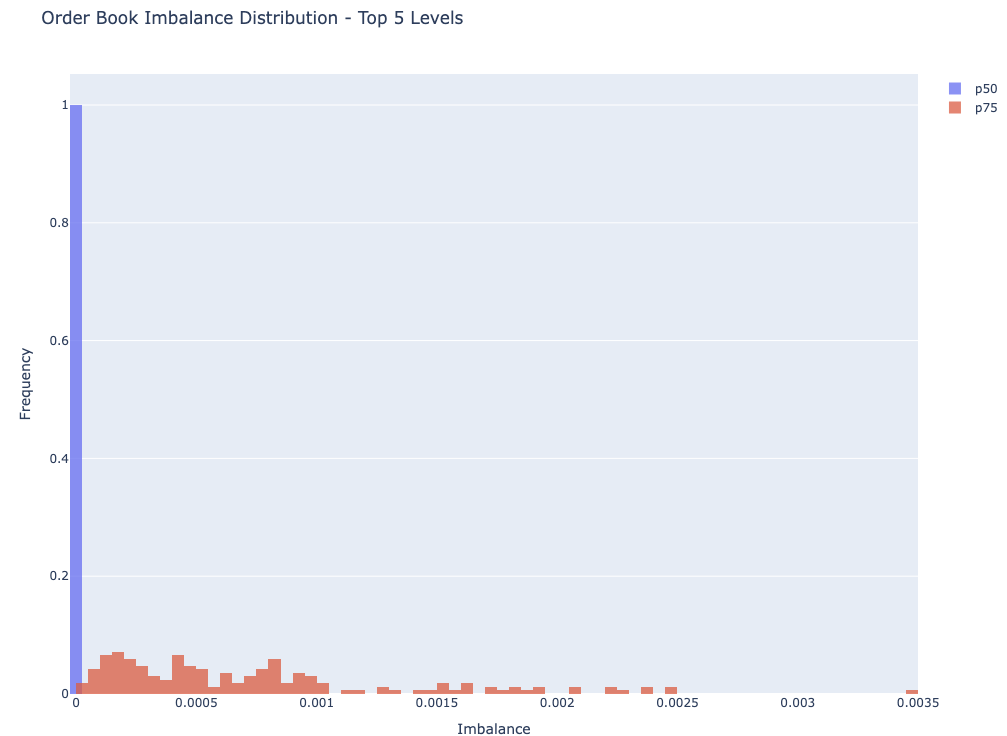
The natural reading here is not simply “the venue is thin.” It is that the inside market is being carefully curated probably by hard flow managing appearances and queue position while the deeper inventory is being rationed much more selectively. The top of the book is the beautifully decorated lobby. The deeper book is the risk committee.
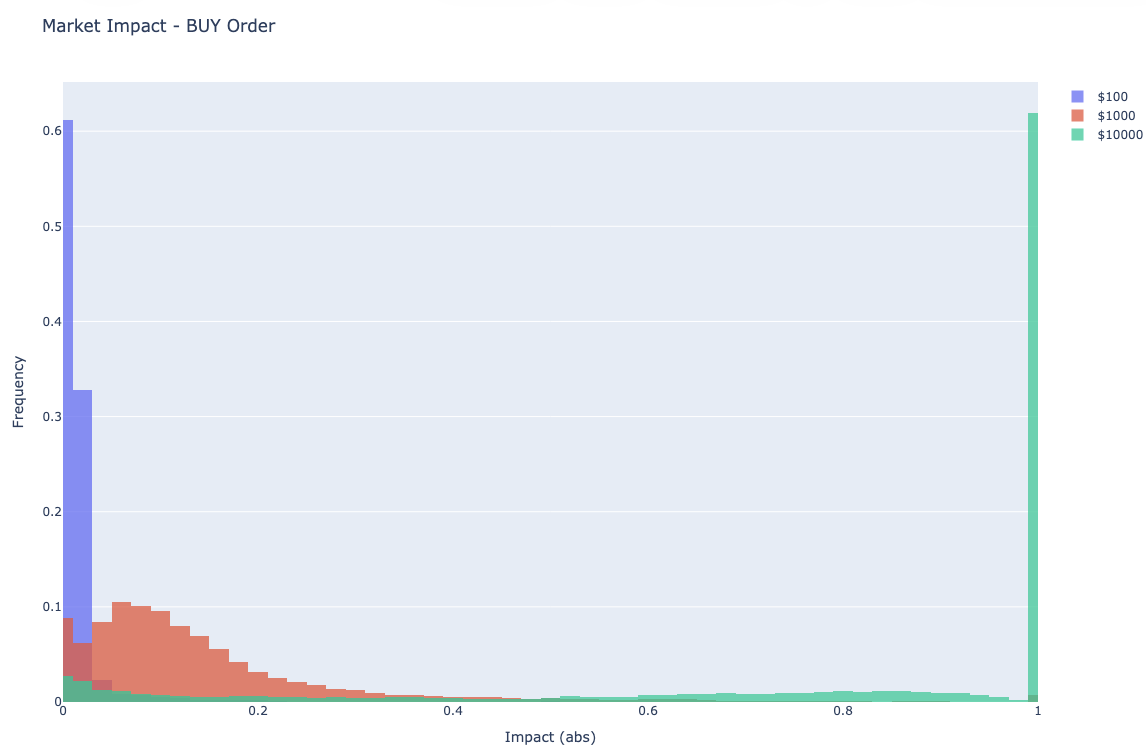
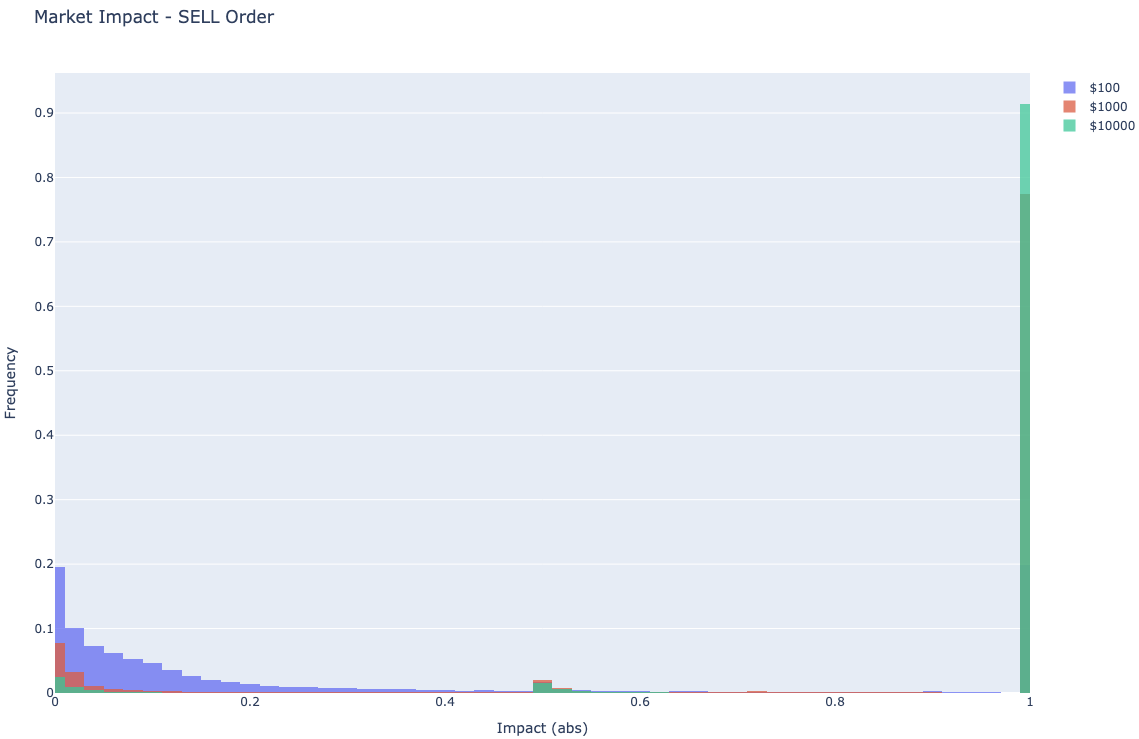
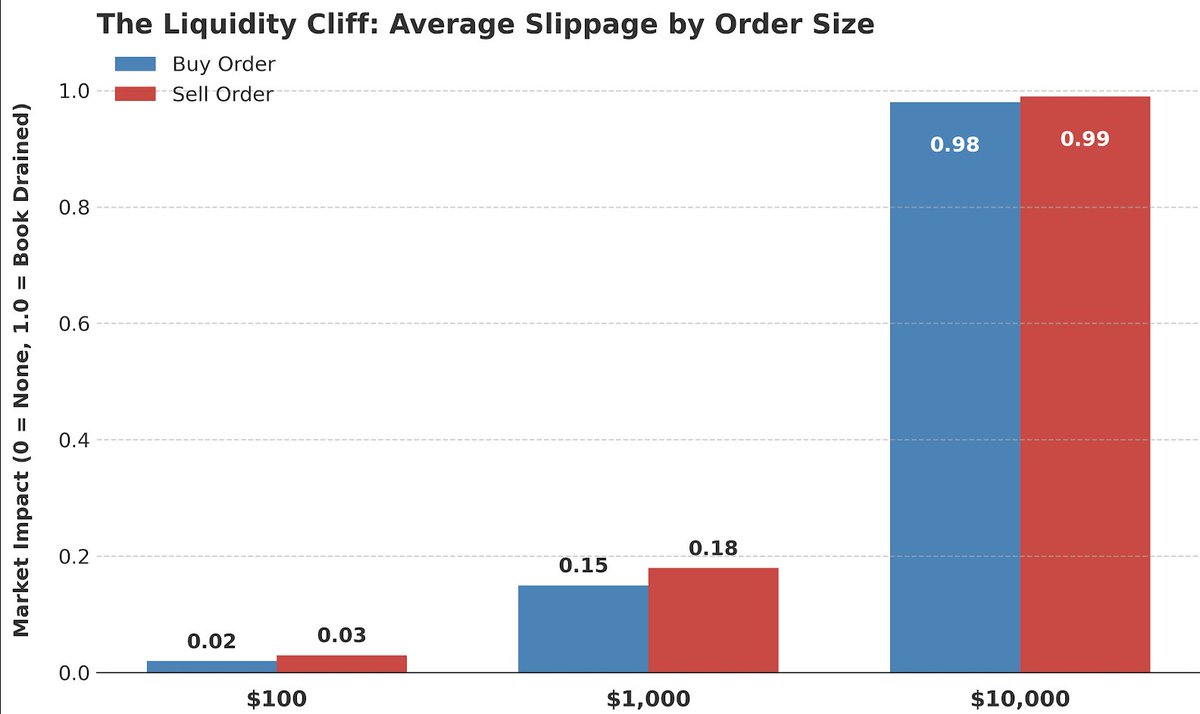
This lines up perfectly with the market impact data. If your market impact is 0.0, your order filled entirely at the best price with zero impact. If your impact is 1.0, you have fully drained the book. Small orders are fine! That is how a retail-facing market should work. But medium-size orders immediately feel slippage, and larger orders often just hit a brick wall.
Polymarket is currently much better at printing a probability than it is at transferring risk. If you are soft flow, you can get a clean-enough opinion into the market. If you are hard flow, you can keep the displayed market alive. But if you are trying to move actual size, you will quickly discover that the headline liquidity and the executable liquidity are not the same thing.
Which brings us to the actual problem. It is not that there is no money. It is that the money is not arranged efficiently.
Part 2: Soft Flow Is the Customer, Hard Flow Is the Service Layer, and AI Flow Is About to Meddle
A healthy market is not a place where professionals build a beautiful machine strictly to trade with each other. A healthy market is a place where professionals make money by serving a massive base of public flow.
Retail flow is the customer. What the hard flow (market makers) wants is a world with lots of diffuse, low-urgency retail flow to narrow spreads and make two-sided quoting economically viable. A market populated only by professionals tends to become functional long before it becomes welcoming; it can remain liquid at the touch but still feel expensive and brittle.
This is where AI flow becomes the wild card.
If bots are just retail flow that never sleeps, they are a force multiplier. In the good scenario, AI flow acts as a maintenance layer. It densifies the typical p50 market. It bridges related markets, clears out stale quotes, and makes the book less empty between human attention spikes.
In the bad scenario, AI flow teaches soft flow to behave like toxic hard flow. It shortens the time between public news and an aggressive market reaction. It makes attention perfectly synchronized. If everyone's bot reads the same news alert and hits the exact same side of the book at the exact same millisecond, that is incredibly expensive for market makers to warehouse.
Does AI make soft flow more serviceable, or does it make it more toxic?
The answer to that question relies entirely on capital efficiency. And prediction markets are unusually prone to wasting liquidity because their payoff structures are so rigidly clean.
Think about it: In Polymarket’s framework, $1 can be split into one Yes token and one No token. If you hold both, you just have $1. In multi-outcome events, only one outcome can win. This means a lot of displayed liquidity on a prediction market is not truly independent risk. A market maker quoting both sides of a binary market is not facing two unrelated states of the world that can both blow up simultaneously.
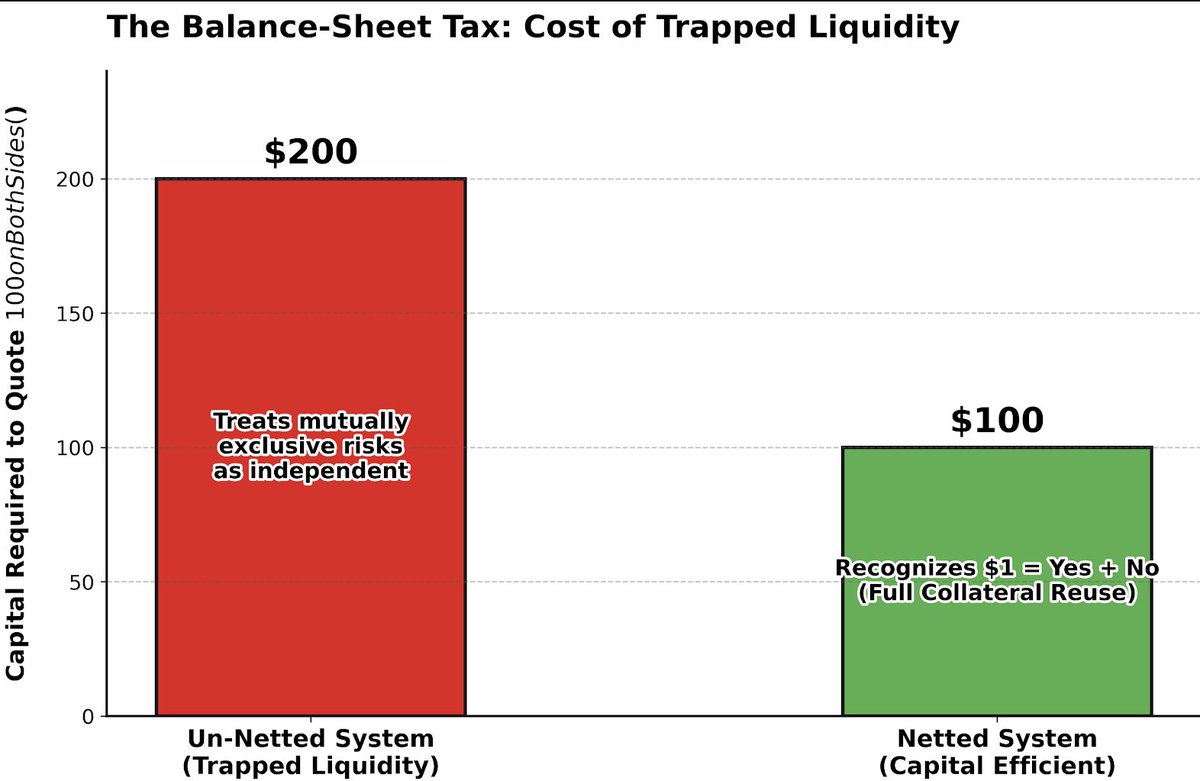
But if the venue's plumbing, or the trader’s internal risk dashboard, still treats those quotes as mostly separate balance-sheet commitments, then the same dollar gets reserved multiple times against risks that cannot mathematically jointly realize.
That is not missing liquidity. That is trapped liquidity.
And trapped liquidity is exactly what your charts look like.
If you can fix the netting if you can allow capital to be reused across mutually exclusive outcomes without treating every quote like an isolated asteroid strike you help everyone. You help soft flow because spreads tighten. You help hard flow because more capital can sit near the touch. And you help AI flow because bots thrive on keeping linked states of the world perfectly aligned.
The ultimate goal isn't to make the p95 screenshot hour look prettier. The goal is to make the p50 median hour less annoying.
The state of liquidity on Polymarket right now is not “bad” or “good.” It is under-composed and under-netted. It relies too heavily on bursts of human attention, and too much of its capital sits in isolated little pockets when the underlying math says those pockets could be linked.
Part of that is market structure. But the rest of it is just plumbing. And in finance, plumbing has a funny habit of looking incredibly boring right up until you realize it was the entire business all along.
Footnote: Data & Methodology ** For those who want to check the math or run their own analysis, the complete data replication package for this article is available **here on google drive
The folder contains:
-
Code: The liq_memo.ipynb Jupyter Notebook containing the exact filtering, sampling, and plotting logic used to generate these findings.
-
Data: The underlying .parquet files (impact.parquet, depth.parquet, imbalance.parquet, spread_trace.parquet, etc.) storing the aggregated order book snapshots, market impact distributions, and open interest metrics.
-
The Charts: High-resolution .png exports of all the visualizations used in Part 1 (oi_p50.png, impact_sell.png, depth_5pct.png, etc.).
(Note: The raw master dataset of 600.82 million observations has been pre-filtered in the provided .parquet files to the 342.99 million research dataset, dropping outcomes with fewer than 10,000 datapoints to filter out noise).