The Election Is in the ETF Now
by @allquantor Here is a basic rule of modern finance. If a thing exists, and people care about it, someone will eventually try to put it inside an Exchange Traded Fund. We have ETFs for stocks and

**by **@allquantor
Here is a basic rule of modern finance. If a thing exists, and people care about it, someone will eventually try to put it inside an Exchange Traded Fund.
We have ETFs for stocks and bonds. We have ETFs for gold and Bitcoin. We have ETFs for companies that do artificial intelligence and companies that make vegan dog food. The ETF is just a box. It is a highly efficient, legally compliant, tax-advantaged box. Wall Street is in the business of finding new things to put in the box.
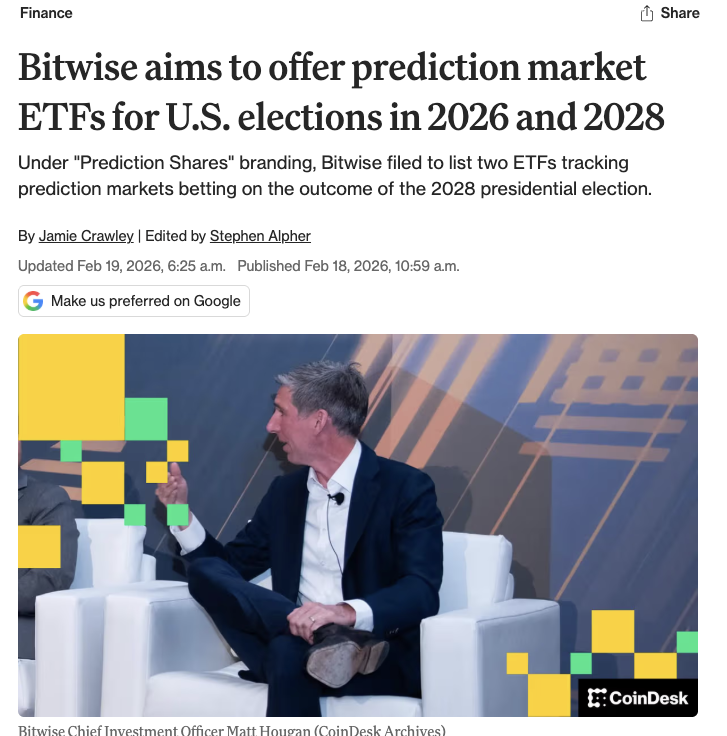
This week, asset managers like Bitwise, Roundhill, and GraniteShares filed paperwork with the Securities and Exchange Commission to launch prediction market ETFs. They want to offer ETFs that track the outcomes of the 2026 US midterm elections and the 2028 presidential election. You will be able to log into your brokerage account and buy a ticker that represents the probability of a Democratic Senate or a Republican President.
This is a fascinating philosophical moment for finance. It is also a completely unhinged mechanical problem. We have talked before about how in finance, the structure is more important than the prediction. A prediction market ETF is the ultimate test of that theory.
An ETF That Only Goes to Zero or One
A normal ETF holds a diversified basket of assets. If you buy an S&P 500 ETF, you own a tiny sliver of 500 different companies. If one of them goes bankrupt, the ETF goes down by a fraction of a percent. It is very hard for an S&P 500 ETF to go to zero.
A prediction market ETF is different. It is a binary option. The underlying event contracts settle at exactly $1.00 if the event happens, and exactly $0.00 if the event does not happen.
The SEC filings for these new ETFs include a very stark warning. They tell investors that if the targeted party does not win the election, the fund will lose substantially all of its value. The ETF will literally go to zero. It will be delisted. It will cease to exist.
Think about what this means for the people buying it. If you are a retail investor who really likes a political candidate, and you put your retirement savings into the Democratic President ETF, you are violating every known rule of portfolio management. You are ignoring the Kelly Criterion. You are maximizing your risk of ruin.
But Wall Street does not care about your personal risk of ruin. Wall Street cares about providing the plumbing. And the plumbing is where things get genuinely optimistic.
The Swap Problem
Think about the poor portfolio manager who has to actually run this ETF.
If you manage a traditional equity ETF, your job is boring. You check the index weights every morning. You buy a little bit of Apple. You sell a little bit of Microsoft. You go play golf.
If you manage a prediction market ETF, your job is a logistical nightmare. You are not a political pundit. You do not care who wins the election. Your job is to make sure the ETF shares outstanding exactly match the underlying assets, and that the price of the ETF tracks the implied probability of the election.
Right now, the filings say these ETFs will use swap agreements tied to contracts traded on designated contract markets. That means they will use CFTC regulated exchanges like Polymarket. The portfolio manager goes to a big bank and says they need a swap that pays out if a specific party wins. The bank sells them the swap, and the bank goes and hedges it on Polymarket.
This is an incredibly clunky way to do things. Swaps have counterparty risk. If the bank goes bankrupt, the ETF breaks. What the portfolio manager really wants is to hold the actual prediction tokens directly.
The Polymarket Plumbing
The most liquid prediction market in the world right now is not a CFTC regulated exchange in Chicago. It is Polymarket, a crypto platform built on the Polygon blockchain.
If Bitwise really wanted to run a perfect prediction market ETF, they would want to hold Polymarket tokens. Structuring an ETF around Polymarket tokens requires a beautiful amount of financial engineering.
Here is how a Polymarket market works. You deposit USDC. You lock it in a smart contract. The smart contract mints two new tokens. One is a YES token, and one is a NO token. Together, one YES and one NO will always equal exactly one dollar. People then trade those tokens on an order book. If YES is trading at 60 cents, NO is trading at 40 cents (*assuming an efficient market here) *
If you are the portfolio manager of a Polymarket ETF, you have to manage the creation and redemption process. When an Authorized Participant, like a big market maker, wants to create 10,000 shares of the YES ETF, here is what they would have to do.
-
First, they take $10,000.
-
Second, they convert it to USDC.
-
Third, they send it to the blockchain.
-
Fourth, they buy 16,666 YES tokens at 60 cents each.
-
Fifth, they deliver those YES tokens to the ETF crypto custodian.
Finally, the ETF issues the shares.
This requires the SEC to approve a crypto custodian to hold binary conditional tokens. It requires the Authorized Participants to have crypto trading desks that are comfortable interacting with decentralized exchanges.
The Oracle Problem
But the most interesting part is the resolution. When the election is over, how does the ETF know who won?
A normal ETF relies on Bloomberg or the New York Stock Exchange. Polymarket relies on a decentralized oracle. This is a voting mechanism where people stake crypto tokens to vote on what happened in the real world.
Imagine being the Bitwise lawyers writing that prospectus. They have to explain that the Net Asset Value of the fund will be determined by an anonymous group of cryptocurrency holders who will vote on the outcome of the US election using a decentralized truth machine. The SEC would have a collective aneurysm.
This is why Bitwise and Roundhill are using boring, traditional swaps tied to CFTC markets for now. The plumbing for crypto prediction markets is simply too weird for the traditional financial system to absorb today.
**
AI Agents **Are Farming Your Political Panic
But there is a bigger picture here. Vitalik Buterin calls this Information Finance. The goal is not gambling. The goal is to use financial incentives to distill high quality information from distributed intelligence.
The entities that are best at this are not humans watching cable news. They are AI agents.
Right now on Polymarket, AI agents are trading millions of dollars. But they are not predicting the future. They are doing what all good finance professionals do. They are ignoring the prediction and focusing entirely on the structure.
Humans trade prediction markets with emotion. A bad poll comes out, and humans panic sell the YES token. The price of YES drops to 40 cents. But the humans forget to adjust the NO token. So NO is still trading at 55 cents.
An AI agent looks at this and sees free money. It buys the YES token for 40 cents. It buys the NO token for 55 cents. It has spent 95 cents to acquire a guaranteed one dollar payout, regardless of who wins the election.
This is called combinatorial arbitrage. The AI agent does not care about politics. It does not read the news. It just looks at the math. It scans thousands of markets in real time, finds pricing gaps, and executes trades faster than any human could click a mouse. It enforces pricing equilibrium across the platform.
Information Finance & Betting Your 401(k) on a Swing State
This is a profoundly optimistic vision of the future. The human forecaster has a fragile, volatile job. They are guessing the future, and if they guess wrong, they lose everything. But the AI agent acts as the ultimate portfolio manager. It manages risk perfectly. It provides liquidity to the market. It makes the implied probability of the market much more accurate for the rest of us.
When you buy a prediction market ETF in 2026, you might think you are betting against another human who disagrees with your political views. You are actually trading against a swarm of AI agents. The humans are supplying the emotional capital. The ETFs are supplying the regulatory structure. And the AI agents are extracting a tiny, risk free toll for keeping the math perfectly balanced.
It is a triumph of financial structure. The prediction is just the bait.