The High Cost of Stealing Homework
The Copycat Trap By @allquantor The Efficient Market Hypothesis In our previous discussions, we covered the labor-intensive risks of prediction markets: doing the research, checking the oracle,
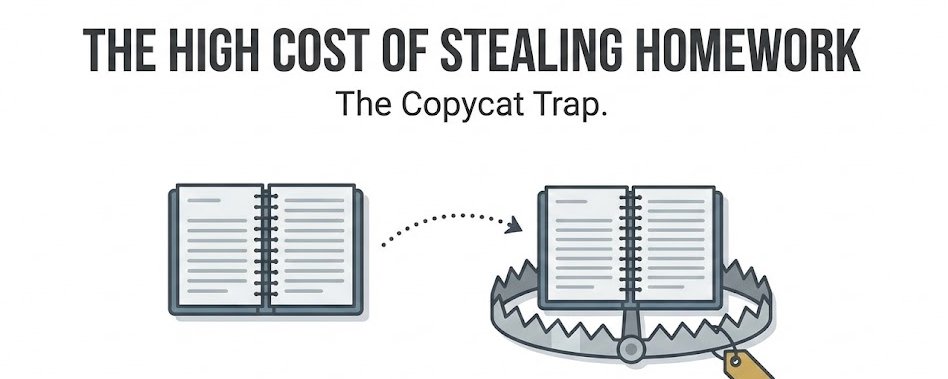
The Copycat Trap
**By **@allquantor
The Efficient Market Hypothesis
In our previous discussions, we covered the labor-intensive risks of prediction markets: doing the research, checking the oracle, calculating the probabilities.
A reasonable person might look at all that work and say:
"No thank you. I will simply find the user on the leaderboard with the highest PnL let’s call him Oracle_Steve and I will buy whatever Steve buys."
This is the "Copy Trading" thesis. In traditional finance, this is known as "13F Watching" (tracking what stocks Warren Buffett bought three months ago). In crypto, it is instantaneous. You can program a bot to buy the millisecond Steve buys.
It feels like a loophole. Steve does the work, you get the profit. It is an arbitrage on Steve’s intellectual labor.
The problem is that financial markets are not designed to let you have the profit without the work. They have a mechanism to prevent this. It is called Price Impact.
The Late Fee
The central awkwardness of prediction markets is that they are small.
If Warren Buffett buys shares of Coca-Cola, the price of Coca-Cola does not immediately double. The pool of liquidity is deep enough to hide an elephant.
If Oracle_Steve buys $10,000 of a niche political outcome on Polymarket, the price moves immediately. He might start buying at 30 cents, but by the time he is finished, he is buying at 40 cents. His average entry is 35 cents.
When your copy-bot fires 200 milliseconds later, you are not buying at Steve’s price. You are buying at the price Steve created. You are buying at 41 cents.
If the "Fair Value" of the bet is 38 cents:
-
Steve bought below fair value. He has Alpha.
-
You bought above fair value. You have Beta (market exposure) plus a surcharge.
You aren't partnering with Steve. You are subsidizing his entry. In the zero-sum game of trading, you are effectively tipping him for the privilege of worsening your own odds.
The Wheat Farmer Problem
The other problem with the blockchain is that it is a perfect record of actions, but a terrible record of intent.
Let’s say you see a sophisticated trader shorting Bitcoin aggressively.
-
The Action: Selling Bitcoin.
-
The Interpretation: "He thinks Bitcoin is going to zero! I should sell too!"
But in the real world (and in DeFi), traders have portfolios.
Maybe this trader just bought $10 million of Bitcoin on Coinbase, and he is shorting $10 million on a prediction market to lock in a yield (a "Cash and Carry" trade). He doesn't care if Bitcoin goes up or down. He is delta-neutral.
If you copy his short position, but you don't have the long position to match it, you are not a sophisticated hedger. You are just a guy who is naked short Bitcoin during a bull run.
You have copied the mechanics of the trade, but you have missed the strategy. It is like seeing a man open an umbrella and assuming that opening umbrellas causes rain.
Alpha Decay and The Heisenberg Uncertainty Principle
There is a concept in quant finance called Alpha Decay.
The moment a profitable strategy becomes known, it stops being profitable because everyone does it, the price moves, and the edge disappears.
If Oracle_Steve is truly good if he actually knows something the market doesn't he has a strong incentive to keep that information private until he has filled his entire position.
If he knows that 500 people are watching his wallet, he faces a dilemma.
-
If he buys first: The copy-traders rush in behind him, pushing the price up. This is actually good for his "mark-to-market" paper gains, but bad if he wants to buy more.
-
If he bluffs: He can buy a token he doesn't want, wait for the copy-traders to pump the price, and then sell into the liquidity they provided.
This creates a paradox: Any trader on the leaderboard who is easily copyable is eventually incentivized to trade against his own copiers.
The act of observing the whale changes the behavior of the whale.
Why Hedge Funds Charge Fees
This is why the traditional "Hedge Fund" structure exists.
You give your money to a manager, and they lock it up for two years. They don't tell you what they are buying today. They tell you what they bought last quarter.
They do this not (just) to be secretive, but to protect the trade.
-
The Hedge Fund Model: You buy a share of the result.
-
The Copy Trade Model: You try to replicate the process.
The former aligns incentives. The latter creates a race to see who can fit through a narrow door the fastest. And in a prediction market, the door is very narrow.
Summary
-
If you copy a trade, you are often paying the "slippage tax" that the original trader created.
-
You can see a trade, but you can't see the hedge. Copying one leg of a spread trade is a great way to lose money with high conviction.
-
If information is free (public on the blockchain), it is worth exactly what you paid for it. Real alpha is usually hidden; visible alpha is usually a trap (or stale).
"Do your own research" is not just a legal disclaimer to keep the SEC happy. It is a description of the only way to capture value. If you are outsourcing your thinking to a wallet address you found on a leaderboard, you aren't investing. You are just providing exit liquidity for someone who did the homework.