The Oracle Problem Is That Oracles Are People
Resolution Risk in Prediction Markets By @allquantor In our previous episodes, we covered Base Risk (you lose because you are wrong) and Liquidity Risk (you lose because the door is too small).

Resolution Risk in Prediction Markets
**By **@allquantor
In our previous episodes, we covered Base Risk (you lose because you are wrong) and Liquidity Risk (you lose because the door is too small).
Today we are talking about Resolution Risk. This is the risk that you are right, but the person keeping score says you are wrong.
In traditional finance, reality is a boring service provided by the government. If you buy a share of Apple, you do not have to worry that the Nasdaq computer will suddenly decide that "Apple" is actually a metaphor for "Despair" and delete your account. The definitions are agreed upon. If there is a dispute, a judge in Delaware decides, and he is usually very boring.
In prediction markets, you are not betting on reality. You are betting on Words.
-
"Will the US launch a ground operation in Mexico?"
-
"Will Russia capture Myrnohrad?"
The problem with Words is that they are squishy. And the people interpreting those words are not impartial judges sent from Delaware. They are either
- (A) an underpaid intern at a think tank who really wants to go home, or
- (B) a pseudonymous crypto whale named 0xGodmode who has a large leveraged position on the outcome.
We call these people "Oracles." And they are the funniest part of the whole ecosystem.
The Map Is Not The Territory
Sometimes, a market resolves based on a specific URL. The contract says: "This market resolves YES if the Institute for the Study of War (ISW) map shows Russian control of Myrnohrad."
This sounds safe. ISW is a serious Washington think tank. They study war. They have maps.
But if you are trading this market, you are not betting on the Russian Army. You are betting on the CMS login credentials of the ISW webmaster.
In late 2025, there was a market on whether Russia would capture a specific intersection in Ukraine. It had over $1 million in volume. On the night of the deadline, the Russian army was nowhere near the intersection.
"NO" shares were trading at 99 cents. It was free money. Then, at 11 PM—one hour before resolution—the ISW map updated.
A tiny, magical red blob appeared, showing Russia holding exactly the intersection needed to trigger the payout.
Polymarket's oracle (which is just a script that scrapes the map) saw the red blob. It resolved the market to YES. "NO" holders were wiped out. "YES" holders made 33,000% returns instantly
.The next morning, ISW rolled back the map. They fired the researcher. They issued a statement saying the edit was "unauthorized."
Basically, someone slipped the intern a Bitcoin (or hacked the WordPress) to paint a red blob.
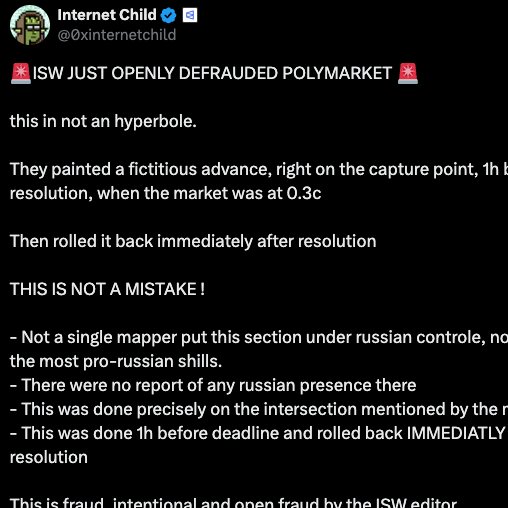
This is Source-of-Truth Risk. You thought you were analyzing geopolitical strategy. Actually, you were analyzing the operational security of a think tank's IT department. You were betting that a guy named "Steve" wouldn't sell his password for $50k. You lost that bet.
Justice By The Pound
When there isn't a single website to trust, Polymarket uses a decentralized judge called UMA.
The theory of UMA is elegant:
-
A dispute happens.
-
Holders of the UMA token vote on the answer.
-
Token holders want the token to be valuable, so they will vote honestly to preserve trust.
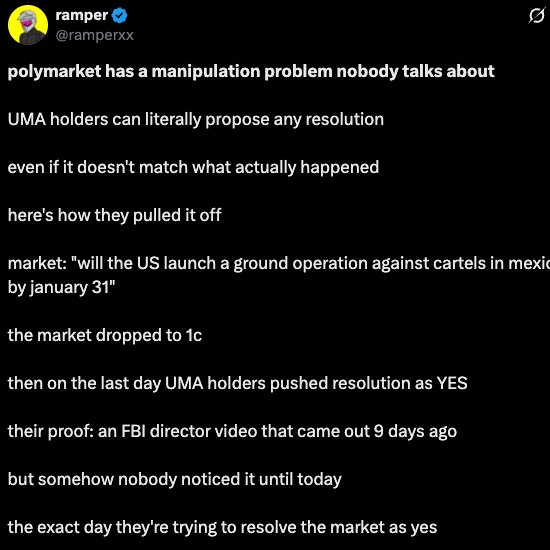
The reality of UMA is that voting is an auction. If I can make $10 million by rigging a market, and it only costs $5 million to buy enough UMA tokens to win the vote, I will simply buy the tokens, vote that "Up is Down," and take my profit.
Consider the market: *"Will the US launch a ground operation against cartels?"
*The Contract Explicitly required "US personnel to directly participate on the ground."
The Reality: The FBI Director released a video mentioning "joint coordination." He did not say US troops were on the ground.
Whales bought "YES" shares for pennies (because, obviously, "coordination" is not a "ground invasion").
Then they went to UMA and voted "YES."
Their argument was, essentially, "The vibes were there." And since they owned the tokens, and they owned the YES shares, their vibes became the law.
This is Governance Risk. The jury is not sequestered -- the jury has a leveraged position on the defendant being guilty.
The "Steve Factor"
After reading all that, you might want to withdraw your money and put it in a mattress. But here is the strange part: Polymarket works.
Billions of dollars trade hands, and 99% of the time, the resolution is boring and correct. The Super Bowl ends, the score is 24-21, and the winner gets paid. The fraudulent intern and the rigged jury are rare.
But they are rare in a way that is priceable.
If you are a smart trader, you don't run away from Resolution Risk. You put it in your spreadsheet.
When you see a "Sure Thing" trading at 98 cents instead of 99 cents, that 1-cent gap is the "Steve Factor."
It is the market explicitly pricing in the non-zero probability that:
-
The Oracle gets hacked.
-
The UMA whales decide to loot the treasury.
-
The intern wants a Lamborghini.
Most of the time, the scoreboard works. But smart traders demand a discount for the possibility that it might break, or lag, or get confused by a technicality. You aren't just betting on the news, you are betting that the mechanism built to record the news will survive the stress of the money riding on it. And that is a much more sophisticated calculation than just picking a winner.