Time-Traveling Out of a Bad Trade
by @allquantor In traditional finance, spoofing is a crime of speed. The basic idea is that you place a massive, terrifying order in the central limit order book to scare people. But you have no
by @allquantor
In traditional finance, spoofing is a crime of speed. The basic idea is that you place a massive, terrifying order in the central limit order book to scare people. But you have no intention of actually executing it.
You write an algorithm that says you would like to buy 10,000 S&P 500 futures contracts. Everyone else in the market sees this and thinks that there is huge demand. They think the price is going to go up, and they should buy now. The price ticks up. You sell your real, much smaller position at the new, higher price. And then comes the crucial part. You cancel your fake 10,000-lot order before anyone can actually sell it to you.

Navinder Singh Sarao famously did this from his bedroom in London. He made millions of dollars and accidentally triggered the 2010 Flash Crash. Traditional regulators hate spoofing. People go to prison for it.
But mechanically, traditional spoofing is a dangerous game. It relies entirely on your cancellation arriving at the exchange a microsecond faster than someone else’s execution. If you are slow, someone hits your fake order. You accidentally buy 10,000 futures contracts right before the market tanks, and you lose all your money. You risk getting your face ripped off.
In crypto, however, financial engineering is bounded only by the absurdities of the plumbing. And the plumbing has just invented a way to spoof the market with absolutely zero capital risk.
The Polymarket Plumbing
Here is a thing that happened on Polymarket recently.
You all know what Polymarket is. It is the best prediction market in the world. But to understand this exploit, you have to understand the ground that Polymarket is built on. Polymarket currently settles its trades on Polygon.
Polygon is a public blockchain. It is a general-purpose, shared computer. Anyone can use it to trade meme coins, buy digital art, or settle prediction market contracts. Because it is a public highway, the validators who run Polygon do not care about fairness. They care about gas fees. If you pay a slightly higher transaction fee, you get to cut the line.
You cannot run a high-frequency trading firm on a slow public highway. So years ago, Polymarket built a very clever, necessary workaround. They built an off-chain "Central Limit Order Book" (a CLOB). It is basically just a normal, fast server.
When you want to bet on an election, you sign a cryptographic message and send it to the off-chain server. The server matches you with a seller instantly. Trading feels fast and fluid. Then, a Polymarket "relayer" scoops up a big batch of these matched trades and submits them to the Polygon blockchain to actually settle the funds.
Polymarket had to build it this way. They are the OGs of this space. When they were inventing the modern crypto prediction market, application-specific blockchains did not exist. Tape-wiring a fast off-chain server to a slow on-chain settlement layer was the only way to make the user experience work.
The Free Option
But this architecture creates a gap. There is a gap in time between agreeing to the trade on the fast server and actually paying for the trade on the slow blockchain.
An attacker realized that this gap is a free option.
Here is exactly how they executed a zero-risk spoof:
-
The Fake Out: The attacker went to the off-chain order book and placed a massive buy order for the Next Prime Minister of the Netherlands.
-
The Match: The off-chain engine matched the order. The market went crazy. The implied probability of this random candidate winning shot up from 0.1% to 35%.
-
The Real Trade: Other trading bots saw this momentum and started adjusting their own prices. This allowed the attacker to quietly profit on their other, real positions in correlated markets.
Now the attacker has a problem. They just agreed to buy a massive amount of tokens for a Dutch politician who is definitely not going to win. They need to cancel the order. But the order is already matched. The Polymarket relayer is currently walking to the Polygon blockchain with a piece of paper that says to take USDC out of the attacker's wallet and give them these useless tokens.
The Bounced Check
So the attacker simply bribes the blockchain.
Before the Polymarket relayer's transaction can be processed, the attacker submits their own transaction directly to Polygon. The transaction says to withdraw all of the USDC from the attacker's wallet. The attacker attaches a slightly higher gas fee to this transaction.
The Polygon validators see the high tip. They process the withdrawal first.
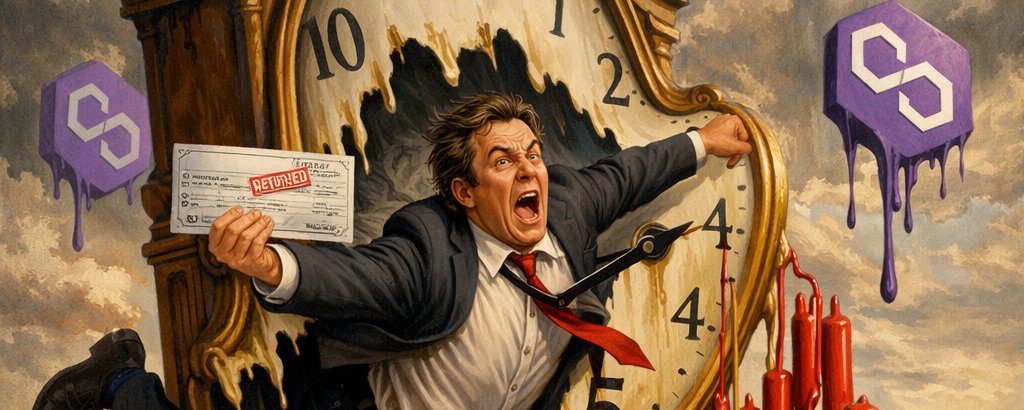
A few seconds later, the Polymarket relayer arrives. The smart contract tries to execute the massive trade. It reaches into the attacker's wallet for the USDC. But the wallet is empty. The check bounced.
The smart contract is dumb. When it sees a bounced check, it just gives up. It reverts the entire batch of transactions. The attacker's trade fails, but so do the trades of a dozen innocent bystanders whose orders were lumped into the same batch.
For the cost of about 1 MATIC in gas fees, which is literally pennies, the attacker successfully manipulated the market. They triggered a denial-of-service attack on the exchange. And they took exactly zero capital risk. Traditional spoofers had to be the fastest guys in the room. Crypto spoofers just have to write a bad check and pay a faster cab driver to take them to the bank.
Building the Ground You Stand On
This is a profoundly annoying market structure problem. But it is not really Polymarket's fault. It is the fault of the underlying shared infrastructure. If you build a pristine financial engine on top of a chaotic public highway, eventually a troll is going to pay a toll booth operator to crash a truck into your trades.
The solution to this is actually incredibly bullish.
Polymarket has simply outgrown Polygon. They are too big to share a computer with random meme coin traders. This exploit is the exact catalyst that proves Polymarket needs to build its own Layer 2 blockchain.
If Polymarket runs its own L2 appchain, they control the "sequencer." The sequencer is the entity that decides what order the transactions go in. If Polymarket owns the sequencer, there is no line-cutting. They can enforce the rules of physics. They can say that if you agree to a trade on the order book, the funds are locked at that exact millisecond. You cannot time-travel out of a bad trade.
The separation of execution and settlement is a feature of traditional finance. But in traditional finance, if you empty your bank account to avoid a trade, you go to jail. In crypto, there is no jail. There is only the code.
The only way to fix it is to own the entire stack, from the order book down to the blockchain itself. Polymarket built the market. Now they just need to build the ground it stands on.