Why You Should Probably Bet on Your Own House Burning Down
by @allquantor Wildfire Derivatives If you are a normal human being with normal human emotions, your reaction to seeing people bet on whether a wildfire will consume a town is probably something like

by @allquantor
Wildfire Derivatives
If you are a normal human being with normal human emotions, your reaction to seeing people bet on whether a wildfire will consume a town is probably something like intense moral revulsion.
A wildfire is a terrifying, life-altering disaster. It is evacuation orders, thick orange smoke, panic, lost pets, and years of bureaucratic nightmare spent trying to rebuild your life from a pile of ash. It is not a roulette wheel.
But if you are a crypto trader or a specific kind of financial theorist, your reaction to seeing people bet on a wildfire is:
*“Ah, an unbundled, low-overhead parametric climate hedge with zero claims-adjustment friction.”
*Both things are true! That is the core weirdness of prediction markets.
In January 2025, while the Palisades and Eaton fires were actively tearing through Los Angeles County, the crypto prediction market Polymarket listed roughly 20 wildfire-related contracts. People sitting at their computers traded about $1.2 million on whether a specific wall of flame would hit a specific acreage, or when it would be contained.
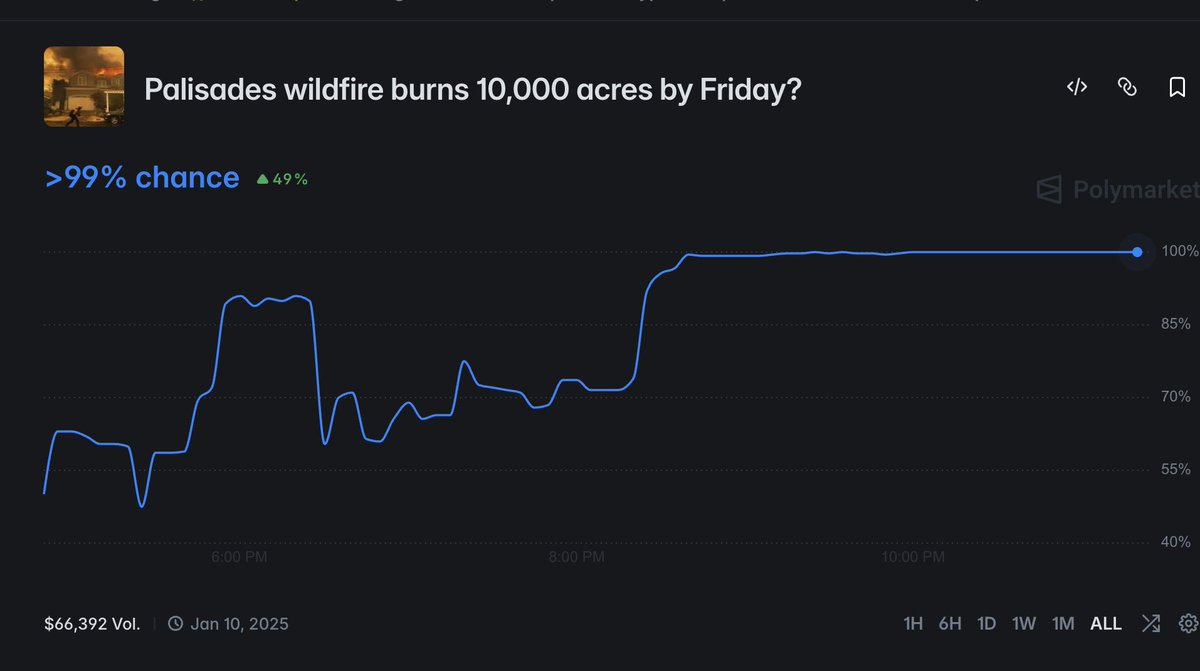
To the people whose neighborhoods were actually on fire, this looked like ghoulish, dystopian gambling. Which, to be fair, it was. But structurally, if you squint, it also looked exactly like a highly efficient retail financial derivative.
An 8-Cent Climate Hedge
There are two ways to do property insurance
The normal way is indemnity insurance. You buy a policy. Your house burns down. You file a claim. The insurance company sends a guy named Craig out to look at the ashes and asks you to provide receipts for the living room couch you bought in 2018. Then Craig quits, and a guy named Gary takes over your file. Eventually, they pay you exactly what they calculate you lost, minus your deductible, minus whatever they decide isn't covered because it was technically "smoke damage" and not "fire damage."
The other way is parametric insurance. Parametric insurance does not care about your couch. It asks a simple, objective question: Did a specific thing happen? Did the local wind speed hit 100 mph? Did the earthquake register 6.5 on the Richter scale? If yes, the machine goes ding and the contract pays out a flat, pre-agreed lump sum.

Prediction markets are not legally insurance policies. Regulators will get extremely angry at you if you call them insurance. But the math of a prediction market is identical to a parametric climate hedge.
Here is how you day-trade your own disaster:
-
Imagine you own a home in a fire-prone California canyon.
-
You look at Polymarket, and a contract that pays out $1.00 if a wildfire crosses into your county boundary before September is trading at 8 cents.
-
You buy 25,000 "Yes" shares. This costs you $2,000 upfront.
-
If the fire stays away, you lose your $2,000. That’s your insurance premium.
-
If the fire crosses the line, your shares redeem for $25,000 gross ($23,000 net).
That $25,000 isn’t going to rebuild a multi-million-dollar home. But it will arrive in your crypto wallet or bank account almost instantly. It can pay for your hotel, your evacuation gas, smoke remediation, boarding your animals, or keeping your small business payroll alive while you wait for the slow, grinding wheels of the actual insurance industry to turn.
The Legacy System is on Fire
The only reason a rational human being would use an offshore crypto prediction market to hedge their home is that the actual, heavily regulated property insurance market in California is having a slow-motion heart attack.
By June 2026, Stanford researchers found that average California homeowners premiums had spiked 84% since the end of 2020. Deductibles jumped from $1,813 to $2,553. Major carriers are just walking away from the state entirely. State Farm stopped writing new policies in May 2023 and non-renewed 30,000 high-risk homes in March 2024.
When polite, private insurers dump you, you fall into the California FAIR Plan, the state’s insurer of last resort.
The FAIR plan is an absolute mess. It is expensive, its coverage is narrow, and it is bloated. By March 2026, the FAIR Plan had 684,388 policies, pulled in $2.02 billion in written premium, and was sitting on a completely terrifying $750 billion in total exposure. In Pacific Palisades, the median was $5,450 back in 2023, before the 2025 fires even happened.

And the FAIR Plan caps out at $3 million and basically only covers fire. If you want coverage for water damage or a burst pipe, you have to buy a completely separate "Difference in Conditions" (DIC) policy. Roughly half of the people on the FAIR Plan just don't bother doing this, meaning half the people living in extreme fire zones are walking around half-insured.
And if you actually need to use the insurance you pay $10,000 a year for?
After the Eaton and Palisades fires, the state reported 41,800 claims filed and $23.7 billion paid out. A United Policyholders survey of Los Angeles fire survivors found that nearly 8 in 10 had serious claim problems:51% reported communication delays.
-
50% said they received a lowball settlement offer.
-
49% experienced payment delays.
-
48% had three or more different adjusters assigned to their file.
Meanwhile, down in Maui after the 2023 fires, reports showed that roughly 40% of insured homeowners discovered they were severely underinsured, facing a median shortfall of $400,000 just to rebuild the structure they thought was covered.

Imagine losing everything you own, living in a Residence Inn, and having to explain to a fourth new guy named Todd that your couch was actually from West Elm.
So, just to recap: The regulated product costs $10,000, covers half your stuff, drops you randomly, takes six months to pay out, and requires you to fight four different corporate bureaucrats on the phone. The crypto product costs $2,000, takes ten seconds to buy, and pays out instantly if a line crosses a map.
Monetizing the Matchbook
There are, of course, some incredibly obvious reasons why letting people bet on fires is a terrible idea.
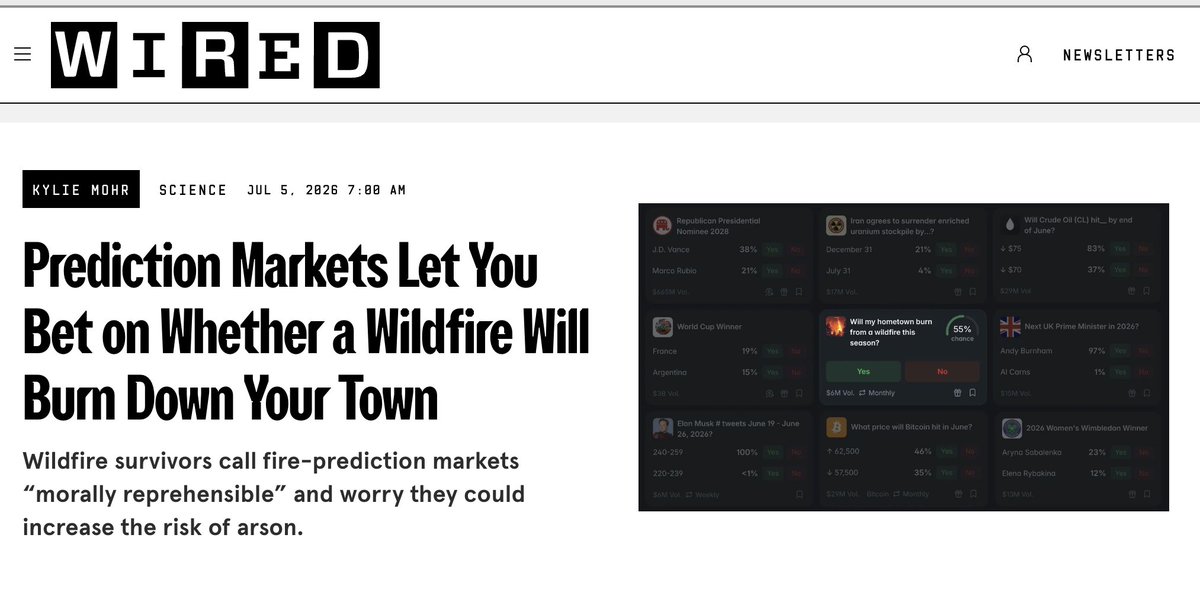
The most glaring one is moral hazard. You cannot deliberately trigger a hurricane or an earthquake. You can deliberately start a wildfire. If a market allows you to buy "Yes" shares on a neighborhood burning, and the payout is uncapped, you have accidentally created a financial incentive for arson.
Furthermore, there is a massive information asymmetry. Firefighters, utility executives, and local emergency managers know where a fire is heading hours before the general public does. If they can trade on that information, the market isn't a hedge; it’s just a way for insiders to front-run the public.
This is why regulators are terrified. In Washington, lawmakers introduced the BETS OFF Act of 2026, which seeks to ban wagering on things like terrorism, war, assassination, and events where an individual can control or know the outcome.

The regulatory war over this is messy:
-
In 2022, the CFTC fined Polymarket $1.4 million for offering unregistered binary options.
-
Polymarket responded by spending $112 million to buy QCEX, a CFTC-licensed derivatives exchange, trying to get inside the regulatory tent.
-
In May 2026, the CFTC went as far as suing the state of Minnesota over a local law that would make operating a prediction market a felony, pointing out that the state’s overly broad language would accidentally criminalize standard corporate weather derivatives.
Routing around the Sludge
The thing about finance is that if you leave a massive pool of unhedged risk sitting out in the sun long enough, someone, somewhere, will figure out how to build a derivative for it.
The point here isn’t that the world is broken and we should all start cheering for disasters. The point is that capital markets are like water: when they hit a giant wall of institutional sludge, they find a different way to flow.
Traditional insurance is a twentieth-century machine built for a predictable world. It has too many committees, too much overhead, and too many claims adjusters who want to look at the ashes of your toaster oven before they write a check. When that machine stops working, the risk doesn't just disappear. People still live in the canyons, and the canyons still catch fire.
So people did what they always do: they engineered a workaround.
Right now, this workaround looks like a cynical crypto casino because that’s just where the digital plumbing happened to be lying around. But if you strip away the speculative optics, what’s left is a genuinely fascinating piece of financial innovation. It is a frictionless, open-source coordination mechanism that lets a renter, a farmer, or a small business owner construct a hyper-specific macro hedge out of thin air, without needing a multinational corporation's permission.

A wildfire will always be a disaster. But a world where software allows a vulnerable family to secure an instant, un-fudgeable cash payout the exact second an objective data point is triggered isn't a dystopia. Don't be fooled.
That is human ingenuity doing what it does best -- routing around a broken system to build a tool that actually works.
Thanks for reading.
The primary sources I used for the article:
-
WIRED / High Country News – Prediction Markets Let You Bet on Whether a Wildfire Will Burn Down Your Town (July 2026)
-
https://www.wired.com/story/prediction-markets-let-you-bet-wildfire/
-
Polymarket – Palisades wildfire market example https://polymarket.com/event/palisades-fire-burns-10000-acres-by-friday
-
Swiss Re – What is Parametric Insurance? https://corporatesolutions.swissre.com/insights/knowledge/what_is_parametric_insurance.html (corporatesolutions.swissre.com)
-
Swiss Re – Parametric Insurance Solutions https://www.swissre.com/our-business/public-sector-solutions/parametric-insurance-solutions.html (swissre.com)
-
California FAIR Plan – Key Statistics (March 2026) https://www.cfpnet.com/key-statistics-data/ (The California FAIR Plan)
-
California FAIR Plan – About https://www.cfpnet.com/about-fair-plan/ (The California FAIR Plan)
-
California Department of Insurance – FAIR Plan https://www.insurance.ca.gov/01-consumers/200-wrr/California-FAIR-Plan.cfm
-
California Department of Insurance – Wildfire Claims Tracker https://www.insurance.ca.gov/01-consumers/180-climate-change/Wildfire-Claims-Tracker.cfm
-
Stanford Woods Institute – California's Home Insurance Crisis Spreads Beyond Wildfire Country https://news.stanford.edu/stories/2026/06/california-home-insurance-crisis-wildfire-country (Stanford News)
-
Reuters – Pacific Palisades insurance costs after wildfires https://www.reuters.com/world/us/pacific-palisades-fire-may-spell-an-end-cheap-homeowners-insurance-california-2025-01-09/
-
United Policyholders – Los Angeles wildfire insurance claim survey https://uphelp.org/after-the-los-angeles-wildfires-80-of-victims-report-serious-insurance-claim-issues/
-
National Conference of State Legislatures – Parametric Insurance Can Offer Prompt Payout When Disaster Strikes https://www.ncsl.org/resources/details/parametric-insurance-can-offer-prompt-payout-when-disaster-strikes
-
BETS OFF Act press release https://ansari.house.gov/media/press-releases/ansari-supports-bicameral-bill-to-ban-prediction-markets-on-government-actions-war-and-events-ripe-for-rigging